How Arguments Against Trans People Mislead by Concealing Their Premises

It’s a Sleight of hand.
Many arguments against trans people work by leaving out important information. This trick is called an ‘enthymeme.’ An enthymeme is when someone makes an argument but leaves out a key idea, and the listener fills in the blank without even realizing it.
This works because some words, like ‘children,’ ‘parents,’ ‘women,’ ‘safety,’ and ‘fairness,’ already make people feel a certain way. These words can make people agree with an argument before they even know what it is really about.
A recent study in Canada found that phrases like ‘protecting children,’ ‘parental rights,’ and ‘gender ideology’ are used to make rules against trans people sound like they are just protecting others, even before it is shown that trans people are a problem.
Here are some of the most important enthymemes I see operating now.
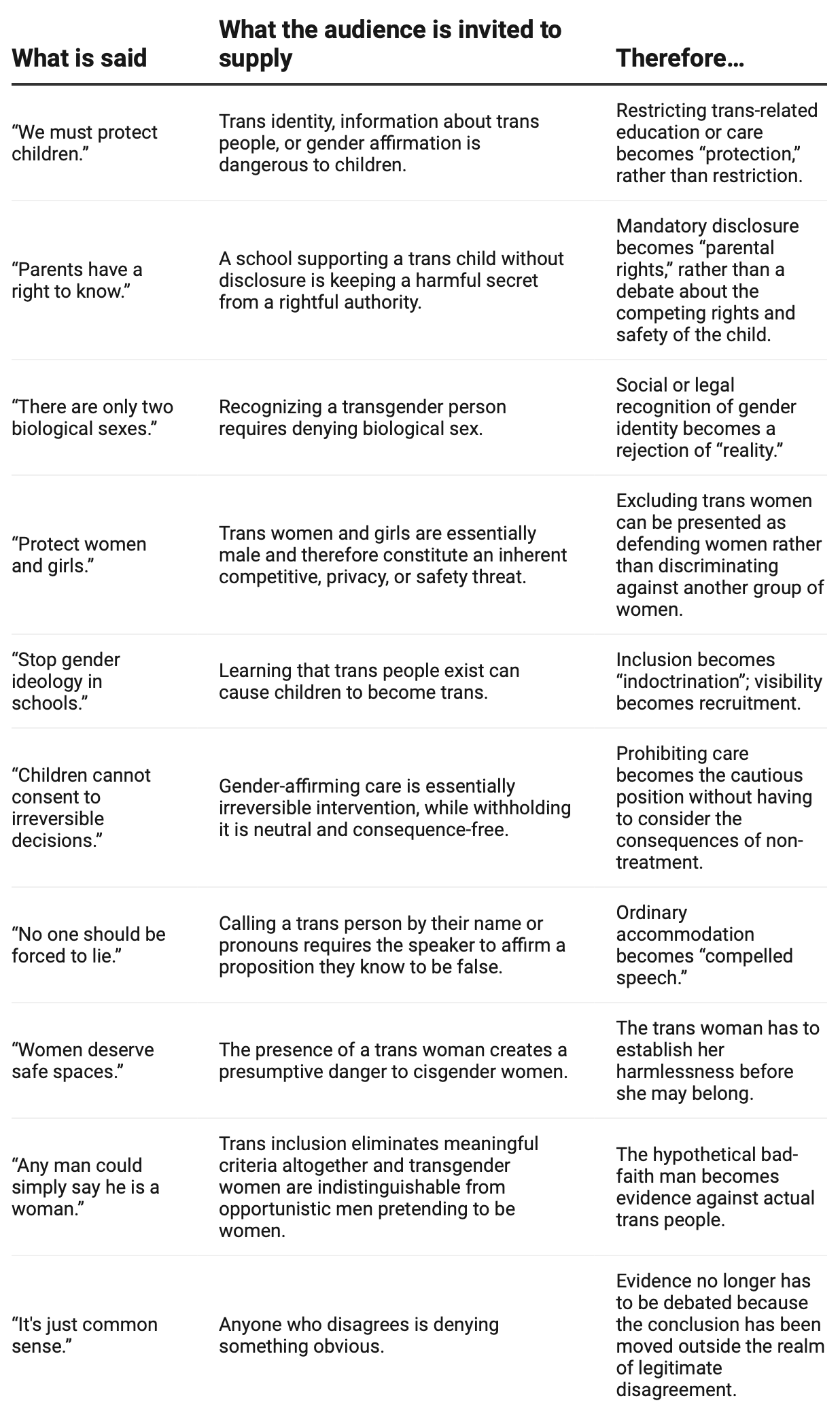
Once you start listening for them, these missing premises show up everywhere.
You can see many of these tricks in how politicians talk today.
For example, some politicians recently said that laws about names, pronouns, and school rules are needed to protect children from ‘gender ideology’ and to give parents more control.
Another group, the Heritage Foundation, puts lots of different ideas together, like protecting children, protecting parents, protecting women, and talking about biological sex. By doing this, it makes it seem like trans people are a threat to all these groups.
Another group, Alliance Defending Freedom, says that ‘gender ideology’ has hurt many people, especially children and women.
The Main Trick
There is a pattern behind most of these arguments.
“We are protecting X.” But what they don’t say out loud is: “Trans people are a threat to X.”
And X can be almost anything, like:
children
parents
women
girls
sports
families
schools
medicine
religion
free speech
truth
biology
civilization
After hearing this over and over, people start to think being trans is something to fear, even if no one says anything directly mean about trans people.
In fact, saying “I have nothing against transgender people” becomes completely compatible with advocating policies that progressively restrict their lives.
That produces another particularly sophisticated enthymeme: “We don’t oppose transgender people; we oppose gender ideology.”
But here is the missing premise: Transgender people can be separated from the supposedly harmful ideas that make social recognition of them possible.
Therefore: We can dismantle the social and legal conditions under which people live openly as transgender while maintaining that we bear transgender people no animus.
The word “transgenderism” does similar work. It turns people into an -ism. You are no longer talking about Lisa, Susan, Jamal, or a twelve-year-old child; you are talking about an ideology. That move is tactical, and researchers of anti-trans discourse have paid close attention to it.
There is another clever trick: the innocent third party
Notice how rarely the political protagonist is actually the transgender person.
It is instead:
• the child being indoctrinated,
• the parent being deceived,
• the girl losing her medal,
• the woman losing her privacy,
• the teacher being compelled to speak,
• the doctor being pressured to practice bad medicine,
• the Christian being forced to violate conscience.
The transgender person appears primarily as the cause of somebody else’s injury. That is rhetorically powerful because the audience is never asked:
“Should transgender people have fewer rights?”
They are asked:
“Don’t children deserve protection?”
“Don’t women deserve safety?”
“Don’t parents have rights?”
“Should government force people to lie?”
Of course the instinctive answer is yes, yes, yes, no. But the enthymeme quietly inserts “Then you should support this restriction on transgender people.”
That is why the phrase “protecting children” has become so central internationally. Recent scholarship specifically describes child protection as a strategic rhetorical device in contemporary far-right and conservative anti-trans discourse.
Alberta gives us a nearly textbook example.
The Government of Alberta calls its 2025 legislation “Protecting Alberta’s Children” and says invoking the notwithstanding clause is necessary to “protect kids, families and fair play.” The measures concern gender-affirming health care, pronoun/name policies and transgender participation in sport.
Notice what doesn’t have to be stated: Protect children from whom or what?
The grammatical construction has already positioned something as the danger. The legislation does not have to be called: “Restricting the rights of transgender minors.” It becomes: “Protecting Alberta’s Children.”
That may be one of the purest political enthymemes in this entire debate. That points to what may be the best response: do not rush to argue with the conclusion. Ask for the missing premise.
When someone says: “We have to protect children.” ask: “Of course. Protect them from what, exactly?”
When they say: “Parents have rights.” ask: “Certainly. Which parents? Do the parents of transgender children who support their children have rights too?”
When they say: “Protect women.” ask: “From what exactly about a transgender woman?”
When they say: “Stop indoctrination.” ask: “What evidence shows that knowing transgender people exist causes someone to become transgender?”
Asking these questions exposes the enthymeme and reveals the syllogism underneath it. Which means that once the hidden premise is spoken aloud, it is less self-evident than “protect children,” “protect women,” “parental rights,” or “common sense.”
That, to me, is the larger point about anti-trans rhetoric. The breakthrough was not getting everyone to openly dislike transgender people. It was getting people to finish the argument themselves, while thinking they were only talking about children, women, parents, safety, and fairness.
In Conclusion
The easiest way to see the sleight of hand may be to take the familiar claim seriously: “We need to protect children.”
Fair enough.
But if that is the principle, then transgender children cannot quietly disappear from the category of children.
Children should be protected from harm.
Transgender children are children.
Therefore, transgender children should be protected from harm.
So whenever a government, organization, or political movement claims that a policy restricting gender-affirming care, school recognition, privacy, or participation is intended to “protect children,” there is a very simple question worth asking:
How does this policy protect transgender children from harm?
Not how does it protect other children from transgender children. Not how does it reassure adults who are uncomfortable with transgender identities. Not how does it satisfy a particular ideological or religious understanding of sex and gender.
How does it protect the trans child?
And if the answer is that transgender children must surrender something—their privacy, their healthcare, their dignity, their participation, or their ability to be known as themselves—in order for everyone else to feel protected, then perhaps the word children was never being used as universally as it sounded.
That is the power of the enthymeme. The word children appears to include everyone while the hidden premise quietly excludes some of them.
Sometimes the best response to rhetorical sleight of hand is simply to ask what has been left unsaid.